It’s 7:40 on a Tuesday morning and my daughter mentions — casually, like it’s nothing — that today is her friend’s birthday party. After school. The one I definitely knew about and definitely wrote down somewhere.
If you’ve ever made an emergency detour to a drugstore for a gift bag and whatever was on the endcap, this post is for you. Because a few years ago I finally got tired of that specific brand of panic and started keeping what I now call a gift stash. It has genuinely changed how I handle birthdays, teacher appreciation, holiday hosting, and every unexpected occasion in between — and it’s saved me a startling amount of money.
Here’s how to build one that actually works, rather than becoming a closet full of things nobody wants.
What a gift stash actually is
It’s a designated bin, shelf, or closet corner where you keep a small rotating supply of good, general-purpose gifts bought ahead of time — usually on sale — so that when an occasion appears out of nowhere, you already have something on hand.
The concept sounds obvious. The execution is where most people go wrong. A stash full of random clearance items you’d never actually want to receive isn’t a stash, it’s a junk drawer with delusions of grandeur. The whole system depends on one rule, which I’ll come back to at the end.
Where to keep it
Somewhere out of sight, but not so out of sight that you forget it exists. A lidded bin on a closet shelf works well. So does an under-bed storage box. What matters is that it’s a single location — the moment your stash is split between three rooms, you’ll stop trusting it, and you’ll buy a last-minute gift anyway.
I keep a small index card taped inside the lid listing what’s in there. Sounds fussy. Takes thirty seconds and means I never have to dig.
Category one: the “any kid” gift
This is the hardest one to get right and the one you’ll reach for most. You need something that works for a child you don’t know well, whose age you’re vaguely guessing at, and whose parents may or may not have opinions about noise, batteries, or plastic.
The sweet spot, in my experience, is something tactile, self-contained, and a little bit exciting to open. Small building sets work. Art supplies work if you pick nice ones. And genuinely, the category that has never once failed me is the surprise toy — anything where the recipient doesn’t know exactly what’s inside until they open it.
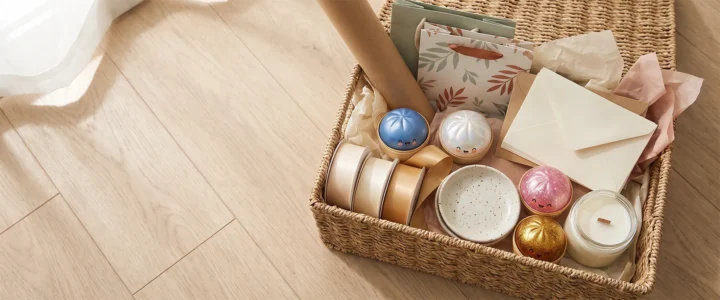
Blind boxes have exploded in popularity for this reason, and they make outstanding stash gifts because the mystery does half the work for you. My kids are currently obsessed with the dumpling-shaped squishies, and dumpling squishy blind boxes have become my default for the six-to-twelve crowd — they’re small enough to keep several on hand, they don’t require batteries, and the not-knowing-what-you’ll-get element turns a two-second unwrapping into an actual moment. I’ve watched a room full of kids crowd around one child opening one. That’s a hard thing to buy for ten dollars.
Buy two or three of whatever you land on. You will use them.
Category two: the neutral adult gift
For the coworker, the neighbor who brought in your packages, the friend who unexpectedly shows up with a gift for you.
Good candidates: a nice candle, a quality tea or coffee sampler, a small ceramic dish, hand cream in a grown-up scent, a beautiful notebook. Nothing that requires knowing someone’s taste in a specific way. Nothing sized or scented so distinctly that it becomes a gamble.
Two or three of these on hand covers nearly every adult occasion that ambushes you.
Category three: teacher and host gifts
These come up more than you’d think, and they’re the easiest to systematize. Teachers reliably appreciate a gift card tucked into a nice card, or a small plant, or a good pen set. Hosts reliably appreciate something consumable — a nice olive oil, a bag of good chocolate, a bottle of something if that suits the household.
Buy these in multiples when you find them on sale. There’s no downside to having three identical hostess gifts. Nobody compares notes.
Category four: consumables and wrapping
Half the last-minute panic isn’t the gift, it’s the packaging. Keep a small supply of gift bags in neutral patterns, tissue paper, a roll of plain kraft paper (works for every occasion, from birthdays to holidays), ribbon, and — critically — a stack of blank cards.
Blank cards over occasion-specific cards, every time. One stack covers birthdays, thank-yous, congratulations, and sympathy.
When to shop for it
The whole financial advantage of a stash comes from buying off-cycle. Post-holiday clearance in January is the single best window of the year. End-of-summer sales are good for outdoor and craft items. And any time you’re already buying something for a specific person and spot a second thing that would work for anyone — grab it.
The mindset shift is small but real: you stop shopping for an occasion and start shopping for the stash. It’s a much calmer way to buy things, and calm shopping is cheaper shopping.
Why this works beyond the convenience
There’s a genuine warmth to being the person who has something thoughtful ready, rather than the person who arrives visibly flustered with a gift bag from the gas station. Research from the Greater Good Science Center at UC Berkeley has consistently found that giving tends to make the giver happier than receiving does — but I’d add a caveat from lived experience: that’s only true when the giving doesn’t come wrapped in stress. Remove the panic and you actually get to enjoy the part where someone opens something you chose for them.
The one rule
Here it is, and it’s the whole system: never stash anything you wouldn’t be happy to receive yourself.
Every failed gift stash I’ve seen — including my first attempt — failed because it became a graveyard for clearance items bought purely because they were cheap. If you wouldn’t want it, someone else won’t either, and you’ll end up buying a real gift anyway while the stash quietly turns into clutter.
Quality over volume. Six good things you’d genuinely be pleased to open beat thirty mediocre ones every single time.
The bottom line
Start small. One bin, four or five items, one index card. The first time a birthday party appears out of nowhere and you walk to a closet instead of a store, you’ll understand why people who do this never go back.
And on that Tuesday morning, when someone mentions a party that starts in eight hours? You’ll just nod, because you’ve already got it handled.